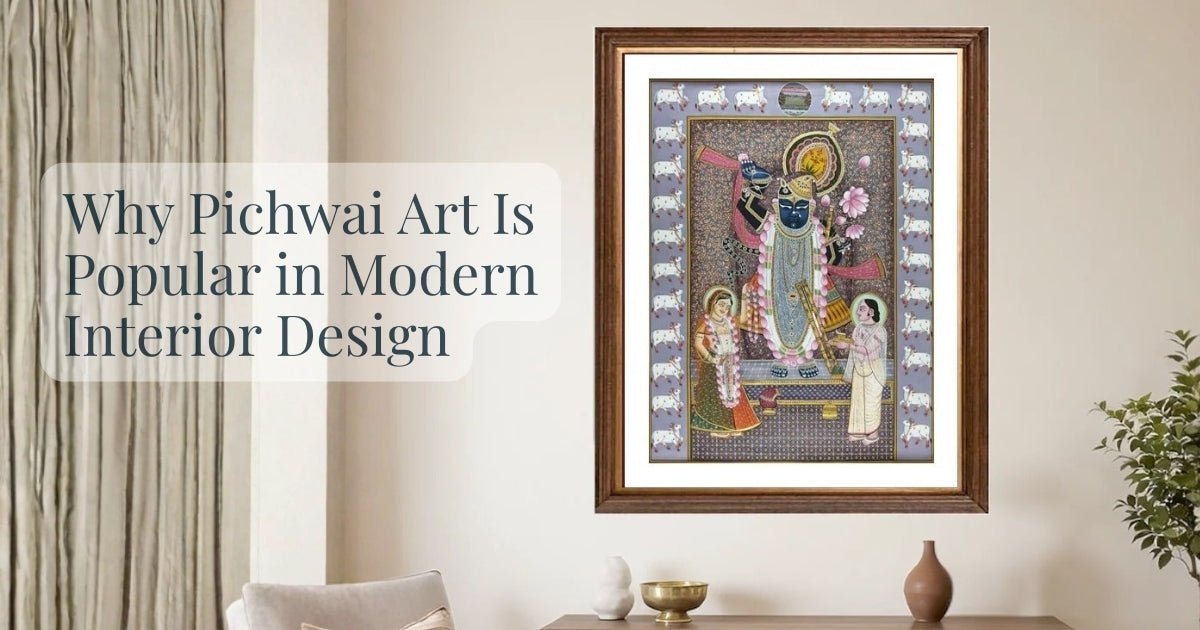
Walk into most contemporary homes and you'll notice a pattern: clean lines, neutral palettes, understated furniture. Yet increasingly, one wall breaks that mould entirely. It's covered in colour, gold leaf, and centuries of craft. That's usually where you'll find pichwai art.
Design Gaatha has built its collection around exactly this contrast , pairing handcrafted Indian artworks with the kind of curation that suits a modern living room rather than a temple hall.
Why Pichwai Art Complements Modern Interiors
Pichwai paintings began nearly 400 years ago in Nathdwara, Rajasthan, where artists created them as ceremonial backdrops for Lord Shrinathji. Lotus blooms, peacocks, grazing cows, and devotional scenes filled every inch of the canvas, painted with a level of detail that took weeks or months to complete.
That history is precisely what makes them work in a modern setting. A pichwai painting doesn't compete with minimalist décor , it anchors it. Place one in an otherwise sparse room and it becomes the single thing a guest's eye goes to first, regardless of whether the house leans traditional or thoroughly contemporary.
Luxury Indian Wall Art That Tells a Story
Most decorative art bought today is printed, framed, and shipped in bulk. Luxury Indian wall art takes the opposite approach , every piece exists because someone sat with a brush and painted it by hand.
A genuine Pichwai painting typically shows:
- Hand-painted detailing built up in fine layers
- Symbolism rooted in devotional and cultural tradition
- Themes that have barely changed in four centuries
- Techniques passed down through generations of artisans
None of that comes through in a printed reproduction. It's the difference between decoration and an actual artistic record.
Traditional Wall Decor with Contemporary Appeal
Good interior design rarely picks a single era and sticks to it rigidly. Most rooms that feel considered mix old craft with new form , and traditional wall decor like Pichwai art sits naturally into that mix.
You'll find it working well in:
- Living rooms
- Dining areas
- Entrance foyers
- Prayer rooms
- Home offices
Against a plain wall, the colours and fine linework do the heavy lifting on their own. A wooden or brass frame adds just enough structure without pulling attention away from the painting itself.
The Beauty of Handmade Paintings
Part of what keeps Pichwai relevant is simple: no two pieces are identical. Handmade paintings carry small variations , a slightly different brushstroke, a shade mixed just a touch differently , that mass production can never reproduce.
Every artisan brings their own hand to the work. The layered colour, the precision in the motifs, the time invested in each piece , all of it adds up to something with actual craftsmanship behind it, rather than a design run off a printer a thousand times over.
Choosing the Right Pichwai Painting
A few practical things are worth thinking through before you buy.
Size
Match the painting to the wall it's going on. Too small and it disappears; too large and it overwhelms the room around it.
Theme
Krishna is the most common subject, but lotus motifs, peacocks, cows, and festive scenes are all widely available too , each carries a slightly different mood.
Colour Palette
Pick a piece whose colours sit comfortably with your existing scheme, but don't be afraid to let it stand out. The painting should be the focal point, not blend into the background.
Placement
Above a sofa, on a console table wall, or facing the entrance of a dining space , anywhere it naturally catches the eye when someone walks in.
Conclusion
Pichwai paintings do something few decorative objects manage: they hold genuine history while still looking entirely at home in a modern room. The detailing, the symbolism, the fact that a real person made it by hand , all of that gives a space something a printed canvas simply can't offer. If you're decorating from scratch or just want to reset one wall, Design Gaatha's collection is worth a look for anyone after authentic, handcrafted Indian art rather than a mass-produced substitute.
FAQs
1. Why is pichwai art becoming popular in modern homes?
Because it does two things at once , carries genuine cultural weight and still looks striking in a minimalist room. The hand-painted detail and devotional themes give a space depth that flat, printed décor rarely achieves.
2. How does luxury Indian wall art enhance interior design?
It adds a layer of craftsmanship and story that mass-produced pieces can't match. Whether the rest of a room is stripped-back or classically furnished, a well-chosen handcrafted piece tends to elevate both.
3. Where should traditional wall decor like Pichwai paintings be displayed?
Living rooms, entrance halls, dining spaces, and prayer rooms all suit it well. The main thing is good lighting on a wall with enough space for the detail to actually read from across the room.
4. Are handmade paintings worth investing in?
Generally, yes. Each one is made individually, so you're getting genuine artisan work rather than a reproduction. Pieces like this tend to hold their appeal for years, and many families end up passing them down.
5. How do I choose the right Pichwai painting for my home?
Start with your wall size and existing colour scheme, then think about mood. Krishna-themed pieces suit prayer rooms and traditional living spaces, while floral or peacock motifs tend to sit better in contemporary interiors. Buying from a genuine, handcrafted source matters more than most people expect.